India’s Trucking Crisis

India Moves on Trucks, but Is Its Trucking Industry Operating Efficiently?
India's logistics industry is the backbone of manufacturing, FMCG, retail, e-commerce and industrial distribution. Every day, trucks transport food, beverages, medicines, steel, consumer goods and essential raw materials across the country.
However, India's transportation challenge is no longer just about moving more goods. It is about moving goods more efficiently, with fewer empty kilometres, better vehicle utilization, safer working conditions and stronger control over transportation costs.
According to NITI Aayog's report, Transforming Trucking in India, road transport accounted for approximately 70% of India's freight movement in 2022, measured in tonne-kilometres. The same report estimated annual freight movement at around 4.6 billion tonnes, generating transportation demand of approximately 2.2 trillion tonne-kilometres.
Research link: NITI Aayog — Transforming Trucking in India: https://www.niti.gov.in/node/384
These numbers demonstrate the scale of India's freight economy. But a large transportation network does not automatically mean an efficient one.
NITI Aayog's research has highlighted persistent issues including low daily truck utilization, empty running, fragmented fleet ownership and driver shortages. The solution requires better planning, better working conditions, improved collaboration and modern technology such as a Transportation Management System (TMS).
1. The Scale of India's Trucking and Freight Industry
India's trucking industry is expected to play an even larger role as manufacturing expands, e-commerce grows and domestic consumption increases. NITI Aayog's report, Transforming Trucking in India, provides a useful baseline for understanding this growth.
| Indicator | Report-era estimate / projection |
|---|---|
| Road share of freight movement (2022) | Approximately 70% |
| Annual freight transported | Approximately 4.6 billion tonnes |
| Annual freight transport demand | Approximately 2.2 trillion tonne-kilometres |
| Projected road freight movement by 2050 | Approximately 9.6 trillion tonne-kilometres |
Source: NITI Aayog, Transforming Trucking in India. Figures relate to different measures of freight activity; the 2050 figure is a projection, not a current observation.
Research link: https://www.niti.gov.in/node/384
As freight demand increases, transporters will need to manage more trips, more customer requirements and more complex distribution networks. Improving existing fleet productivity is an important opportunity because every additional truck brings capital expenditure, maintenance, insurance, fuel and driver requirements.
2. Why Are Indian Trucks Not Being Utilized Efficiently?
Truck utilization is not a single metric. It includes kilometres travelled each day, the share of distance driven with cargo, capacity utilization, time spent waiting or loading/unloading, and productive trips completed over a defined period.
NITI Aayog's national freight research has cited the following report-era indicators:
| Operational indicator | Estimate cited in report |
|---|---|
| Daily truck utilization | 250–400 km |
| Distance travelled without cargo | 28–43% |
| Daily utilization in BRICS peer comparison | Around 500 km |
| Daily utilization in US and Europe comparison | Around 700–800 km |
These are report-era estimates and should not be interpreted as verified 2026 fleet-wide measurements.
Research link: NITI Aayog — Freight Report: National Level: https://www.niti.gov.in/sites/default/files/2021-06/FreightReportNationalLevel.pdf
Problem 1: Empty running and the missing return load
Consider a truck transporting FMCG products from Kolkata to Guwahati. The vehicle delivers the shipment successfully. However, if the transporter cannot find a suitable return load, the truck may travel back empty or wait for the next assignment. The transporter still incurs costs associated with fuel, driver compensation, maintenance, tyres and vehicle ownership.
A more coordinated approach identifies suitable return loads before or during the outbound trip, matching available freight with vehicle capacity, delivery windows and route constraints. This can improve round-trip economics and reduce avoidable empty running.
Problem 2: Poor order planning and vehicle allocation
Many transport operations still depend on phone calls, spreadsheets, manual calculations and individual experience to decide which vehicle should carry which order. This can lead to oversized vehicles being assigned to small shipments, missed consolidation opportunities, poor vehicle availability information and outdated plans when customer orders change.
An automated order planner can evaluate order quantities, destinations, vehicle capacities, delivery windows and business rules before suggesting an allocation. The objective is to dispatch the right vehicle, with the right load, on the right route, at the right time.
Problem 3: Limited visibility into fleet performance
A transporter may know how many trucks are registered with the business but may not know their true operational status. Managers need to know which vehicles are available, delayed, idle, awaiting delivery confirmation or due for maintenance. Without consolidated information, decisions are often reactive rather than proactive.
3. The Driver Shortage: India's Human Resource Challenge in Trucking
Fleet utilization is not only a technology problem. It is also a people problem. A vehicle cannot generate productive kilometres without a qualified driver who is available, fit to drive and properly supported.
NITI Aayog's freight research has highlighted the relationship between driver shortages, poor working conditions and underutilized trucks. An earlier national report cited approximately 28% of the truck fleet as idle due to a shortage of drivers. This is a historical report finding, not a verified current estimate.
Research link: https://www.niti.gov.in/sites/default/files/2021-06/FreightReportNationalLevel.pdf
Why is truck driving an unattractive profession for many workers?
Long working hours: Drivers can face demanding schedules and pressure to complete deliveries quickly.
Poor roadside facilities: Access to clean toilets, safe parking, suitable food and rest facilities remains an important concern.
Income uncertainty: Inconsistent payment structures and a lack of standard employment arrangements can make financial planning difficult.
Time away from family: Long-haul drivers may spend extended periods away from home.
Road safety and health: Fatigue, poor vehicle maintenance and inadequate rest can increase health and accident risks.
A 2020 SaveLIFE Foundation study, Study on the Status of Truck Drivers in India, reported that 48% of surveyed drivers rated their working conditions as bad. Among drivers dissatisfied with their conditions, 51.4% identified long working hours as a reason, while 38.3% cited the lack of fixed salaries or wage standardization. These findings describe the surveyed population at the time, rather than all drivers today.
Research link: https://savelifefoundation.org/wp-content/uploads/2020/02/design-single-page-27th-feb-2020.pdf
Can technology help address the driver shortage?
Technology cannot solve every structural problem. It cannot replace safe roads, fair compensation, adequate rest facilities or better employment conditions. However, it can help transporters organize operations more effectively through realistic route planning, digital trip instructions, shipment visibility, delay alerts and better records of waiting times.
Technology should support safer working practices, not encourage drivers to drive longer hours or skip rest periods. The objective should be to reduce unnecessary waiting and poorly planned trips while protecting driver welfare and road safety.
4. Why Traditional Fleet Management Is No Longer Enough
India's trucking sector has a fragmented ownership structure, with many operators managing small fleets. NITI Aayog's research highlights how smaller operators can have limited capacity to invest in digital tools, larger vehicles and specialized operational expertise.
Research link: NITI Aayog trucking research: https://www.niti.gov.in/node/1182
For many transporters, the daily workflow may still involve receiving load requests over the phone, recording trips in Excel or a register, assigning vehicles manually, creating LRs, calling drivers for status updates, collecting delivery documents and calculating expenses separately.
This approach may be manageable for a few vehicles. As the fleet grows, manual coordination becomes more difficult. A missing document can delay billing, a missed status update can hide a delivery delay, and an idle truck may remain unnoticed.
The problem is not that spreadsheets have no value. The problem is that disconnected tools often lack a single, reliable view of the entire trip lifecycle. A modern TMS connects order planning and vehicle allocation to tracking, proof of delivery, invoicing and financial analysis.
5. How TMS Software Can Improve Truck Utilization
A Transportation Management System is designed to coordinate transportation activities through a connected digital workflow. For transporters and manufacturers, the objective is to improve control over orders, vehicles, trips, freight costs and service performance.
5.1 Automated order planning
An order planning engine can evaluate pickup and delivery locations, shipment quantity, weight and volume, vehicle capacity, delivery windows, route restrictions and customer-specific rules. It can suggest suitable allocations and compatible consolidated loads.
Business benefit: Less manual planning, better vehicle allocation and fewer avoidable trips.
5.2 Dynamic route optimization
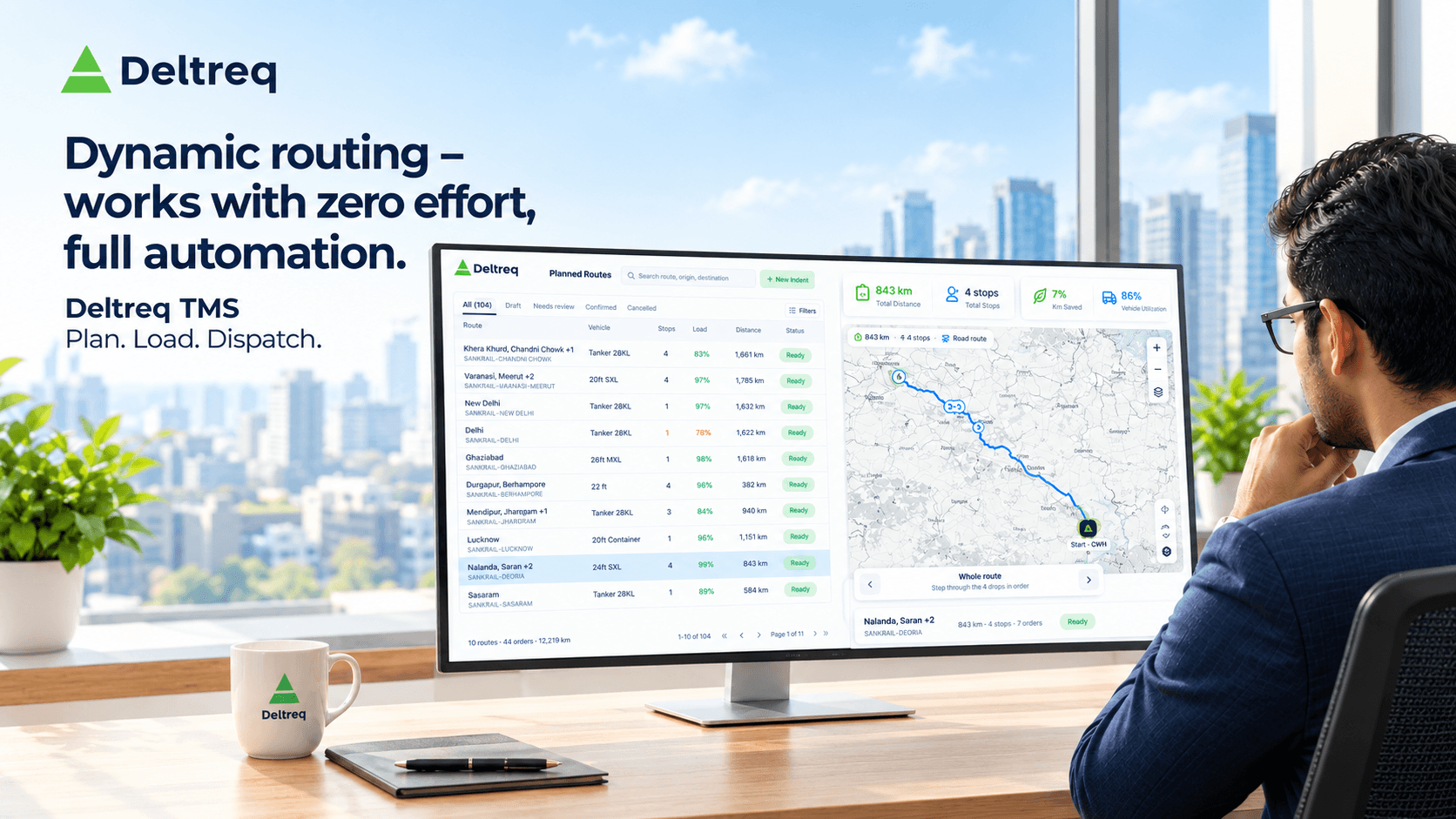
A practical plan must account for delivery windows, road restrictions, vehicle types, customer priorities and the sequence of delivery locations. Dynamic route optimization can help improve stop sequencing, reduce unnecessary kilometres and support more reliable schedules.
Business benefit: Better route productivity and improved delivery planning.
5.3 Real-time vehicle tracking
Connected tracking lets teams monitor vehicle movement and shipment status, identify exceptions and communicate with stakeholders. Alerts may include late reporting, unexpected stoppages, hub delays, route deviations and delivery confirmation pending.
Business benefit: Earlier intervention, better coordination and improved customer communication.
5.4 Digital LR, POD and invoicing
A trip may require a lorry receipt, shipment documents, proof of delivery, transporter invoice verification, deductions and payment reconciliation. A connected TMS can link the trip record with its LR, delivery confirmation, invoice and associated expenses.
Business benefit: Better documentation, faster reconciliation and improved billing control.
5.5 Vehicle maintenance and fleet health
Fleet tools can maintain vehicle records, track service schedules, record breakdowns and identify recurring maintenance issues. Utilization must be balanced with preventive maintenance, vehicle availability and safety.
Business benefit: Better fleet availability planning and fewer avoidable disruptions.
5.6 Trip-wise profitability and financial visibility
A TMS integrated with suitable financial workflows can help compare trip revenue with recorded costs, including fuel, tolls, driver expenses, maintenance allocations and other trip-specific charges.
Business benefit: Better pricing, cost control and fleet investment decisions.
Illustrative trip financial calculation
| Trip financial metric | Illustrative amount |
|---|---|
| Freight revenue | ₹18,000 |
| Fuel expense | ₹6,000 |
| Toll expense | ₹1,500 |
| Driver expense | ₹1,000 |
| Other trip expenses | ₹2,000 |
| Contribution before other overheads | ₹7,500 |
Illustrative example only. These are not actual Deltreq customer results. The calculation excludes any unlisted costs and should not be treated as net profit.
6. Deltreq TMS: Moving From Manual Transport Operations to Digital Fleet Management
For transporters and supply chain businesses looking to modernize their operations, Deltreq TMS provides a technology-driven approach to transportation management. Rather than managing order planning, vehicle allocation, tracking, documentation and financial information through disconnected workflows, businesses can use a TMS to bring key activities together.
Key capabilities
Automated order planning and vehicle allocation.
Trip creation, LR generation and transportation documentation.
Driver app and trip-status visibility.
Route planning and shipment monitoring.
Idle vehicle identification and fleet performance tracking.
Invoicing, expense tracking and trip-wise profit-and-loss visibility.
Product note: Capabilities listed reflect the Deltreq product positioning provided for this blog. Confirm feature availability and integration requirements for the particular deployment.
How Deltreq TMS can support better fleet utilization
Consider a transporter operating 100 vehicles across multiple routes. Without consolidated information, the operations team may struggle to identify vehicles that have completed a trip, vehicles waiting for dispatch, or vehicles that could be assigned to a suitable return load.
With a connected TMS workflow, the team can use trip status, planned routes and vehicle availability information to make better dispatch decisions.
Orders are collected and reviewed.
The planning engine suggests vehicle allocations.
Trips and transport documents are generated.
Drivers receive the relevant trip information.
Operations teams monitor progress and exceptions.
Delivery confirmation is captured.
Invoices, expenses and trip profitability are reviewed.
Available vehicles are considered for their next suitable assignment.
This creates a more structured operating model and gives managers better information for improving fleet productivity. Deltreq TMS is relevant to businesses managing complex distribution, multi-drop deliveries, multiple vehicle categories and recurring transporter operations.
The goal is simple: better planning, better visibility and better control over every trip.
7. How to Measure the ROI of a TMS
A digital system should not be judged by the number of features it contains. Its business value should be measured through operational results. Before deploying a TMS, transporters should establish a baseline and agree on measurable performance indicators.
| KPI | What it measures |
|---|---|
| Empty-running percentage | Share of distance travelled without cargo |
| Vehicle utilization | Productive use of available fleet capacity and time |
| Trips per vehicle | Completed trips per vehicle over a defined period |
| Freight cost per unit | Transportation cost per case, tonne or shipment |
| On-time delivery | Deliveries completed within the agreed window |
| Vehicle downtime | Time vehicles are unavailable for productive operations |
| Billing cycle time | Time between delivery/document completion and invoice submission |
| Trip contribution | Revenue less defined trip-level costs |
An illustrative fleet productivity calculation
Suppose a transporter operates 100 trucks and identifies an opportunity to increase the average number of productive trips completed by its existing fleet. If each truck completes one additional productive trip per month, the fleet generates 100 additional trips monthly.
| Assumption | Illustrative result |
|---|---|
| Additional trips per month | 100 |
| Contribution per trip | ₹2,000 |
| Potential additional monthly contribution | ₹2,00,000 |
| Potential annual contribution | ₹24,00,000 |
These figures are a scenario, not a forecast or a guaranteed TMS benefit. They exclude software costs, incremental operating expenses and other constraints. A sound ROI assessment should also account for implementation costs, training, data quality, integrations and employee adoption.
8. A Practical 90-Day Roadmap for Fleet Digitization
Days 1–30: Assess and establish the baseline
Map the current trip lifecycle, identify manual work, measure empty running, review vehicle utilization and document existing dispatch and billing processes.
Days 31–60: Configure and pilot
Configure vehicle and transporter masters, business rules, trip workflows, tracking and documentation. Train a selected operations team and pilot the system on a defined set of routes.
Days 61–90: Evaluate and improve
Compare pilot performance against the baseline. Review utilization, delays, cost per trip, billing cycle time and user adoption. Correct workflow gaps before expanding the rollout.
The 90-day timeline is a suggested implementation approach, not a guaranteed deployment period. Actual duration depends on fleet size, integrations, data readiness and business complexity.
9. What Transporters Should Look for When Choosing a TMS
Ease of use: Can planners, drivers and finance teams adopt the system without excessive complexity?
Planning capability: Does it support vehicle allocation, load consolidation and route constraints?
Operational visibility: Can the team identify delays, idle vehicles and incomplete trips?
Financial control: Can trip revenue, expenses, invoices and deductions be reconciled?
Configurability: Can the system support different customers, vehicle types and business rules?
Integration: Can it exchange data with ERP, warehouse and finance systems where required?
Reporting: Does it provide reliable metrics for cost, utilization, service and profitability?
Implementation support: Is there a clear process for onboarding, training and ongoing assistance?
The right TMS is not simply the system with the most features. It is the one that addresses the business's most important operational problems and produces measurable, sustainable improvements.
10. The Future of Indian Trucking: From Fleet Ownership to Fleet Intelligence
India's freight demand is expected to grow substantially over the coming decades. NITI Aayog projects road freight movement to rise from approximately 2.2 trillion tonne-kilometres in the report's baseline to around 9.6 trillion tonne-kilometres by 2050.
Research link: https://www.niti.gov.in/node/384
Meeting that demand efficiently will require several complementary improvements:
Better road and logistics infrastructure.
Improved driver working conditions and safety.
More efficient dispatching and load consolidation.
Greater adoption of digital transport systems.
Better integration between manufacturers, transporters and logistics service providers.
Improved measurement of costs, service performance and fleet productivity.
Technology alone cannot eliminate every challenge. However, a well-implemented TMS can provide the visibility and operational discipline needed to identify inefficiencies and take action.
Conclusion: The Future Belongs to Smarter Transportation
India's trucking industry is essential to economic growth, but persistent inefficiencies continue to create avoidable costs and operational complexity. Empty running, driver shortages, manual dispatching, limited visibility and disconnected financial processes all affect how effectively trucks are used.
The answer is not simply to add more vehicles. It is to improve how existing vehicles, drivers, loads and routes are managed.
Modern TMS platforms can support this transformation by connecting order planning, vehicle allocation, tracking, documentation, invoicing and trip-level financial analysis.
Deltreq TMS is built around this opportunity: helping transportation businesses move from manual coordination towards smarter, more connected fleet management.
If you are a transporter, fleet owner or supply chain leader looking to improve fleet visibility, simplify transportation workflows and make better decisions using operational data, explore Deltreq TMS and evaluate how it could fit your business.
Research and References
1. NITI Aayog — Transforming Trucking in India
Freight demand, road transport share, trucking growth and structural challenges.
https://www.niti.gov.in/node/384
2. NITI Aayog — Freight Report: National Level
Truck utilization, empty running, driver shortages and operational inefficiencies.
https://www.niti.gov.in/sites/default/files/2021-06/FreightReportNationalLevel.pdf
3. SaveLIFE Foundation — Study on the Status of Truck Drivers in India
Survey findings on drivers' working conditions, hours and compensation concerns.
https://savelifefoundation.org/wp-content/uploads/2020/02/design-single-page-27th-feb-2020.pdf
4. NCAER — Logistics Cost in India: Assessment and Long-term Framework
Research on logistics cost measurement and data-driven planning.
https://ncaer.org/publication/logistics-cost-in-india-assessment-and-long-term-framework/
5. International Council on Clean Transportation (ICCT) — Total Cost of Ownership of Heavy-Duty Trucks in India