Best TMS Software for Multi-Hub 3PL Companies in India | TMS + OMS
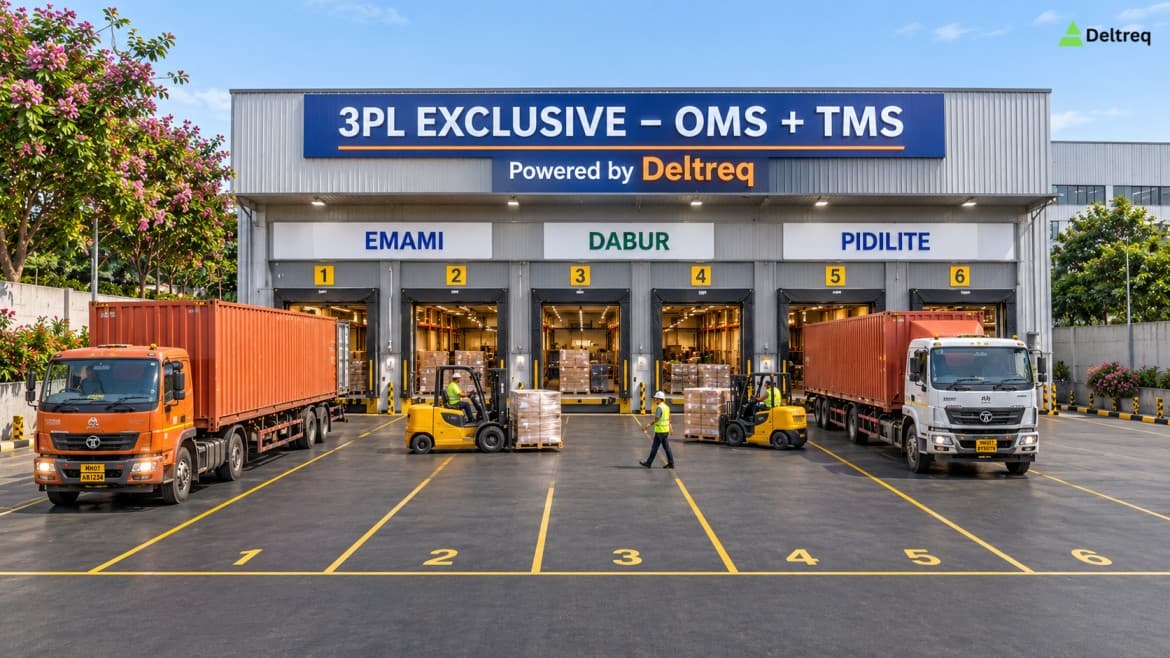
The 3PL Business Has Outgrown the Freight Register
India's third-party logistics (3PL) sector is expanding fast. E-commerce, FMCG, retail, steel, pharma and manufacturing are all outsourcing transportation, warehousing and distribution. Large and mid-size logistics players run networks of hubs, branches, transshipment points and partner transporters to serve many customers at once.
Yet a surprising number of these operations still depend on freight registers, Excel sheets, WhatsApp groups and disconnected tools to run their most important activity: moving customer cargo and getting paid for it.
This works when you have one hub and a handful of vehicles. It breaks down the moment you add a second hub, a third customer and a fleet that mixes owned, attached and market vehicles.
This blog explains where multi-hub 3PL operations struggle, what a modern TMS must offer, and how Deltreq TMS with integrated OMS and Fleet Management brings the full cycle, from customer order to final invoice and transporter payment, onto one platform.
What Does a Multi-Hub 3PL Operation Look Like?
A typical multi-hub 3PL company in India:
• Operates several hubs or branches across states, each with its own team and local transporters.
• Serves multiple customers, each with different order formats, rate cards and billing rules.
• Uses a mix of vehicles: own fleet, attached, leased and market-hired.
• Handles line-haul, first-mile and last-mile movements, often with consolidation and transshipment at hubs.
• Must bill customers on per-kg, per-CFT, per-trip or contract-based terms, and pay transporters on separate agreed rates.
Many well-known names in Indian logistics, such as Allcargo Logistics, Kerry Indev Logistics work in this multi-hub, multi-customer model. Whatever systems each of them has built internally, the underlying operating challenge is the same, and it is shared by hundreds of smaller regional 3PL and transport companies that do not have the budget to build custom software.
Note: Company names are used only as examples of multi-hub logistics networks in India. They do not imply that these companies use or do not use any particular software.
The Hidden Cost of Managing Freight in Registers
For many growing 3PL operators, the real situation looks like this:
• Multiple hubs, no single system. Each hub keeps its own register or Excel file. Head office sees the numbers days later, if at all.
• Freight recorded manually. Trip details, vehicle numbers, agreed rates and advances are written in registers and re-typed into billing sheets.
• No hub-wise visibility. Management cannot see, in one place, how many trips are running, delayed or pending POD at each hub.
• Rate disputes. Agreed rates live in phone calls and chats, so transporter bills are verified from memory.
• Slow billing. Client invoices wait for POD, trip sheets and manual freight calculation, so cash collection is delayed.
• Leakage and errors. Duplicate payments, missed detention charges, unbilled trips and incorrect GST calculations quietly reduce margins.
• Poor fleet cost control. Fuel, repairs, EMI and driver costs are not linked to vehicle-wise income, so nobody knows which vehicle actually makes money.
The register is not the problem on its own. The problem is that a register cannot connect orders, trips, tracking, billing and payments across hubs.
Why a Basic TMS Is Not Enough for 3PL
Some companies try a basic transport management tool and still struggle. A 3PL business needs more than trip entry. It needs one platform that connects:
1. Order Management (OMS) for multi-customer orders
2. Transportation Management for planning and execution
3. Fleet Management for own and market vehicles
4. Freight Procurement for rates and vehicle sourcing
5. Tracking and Control Tower for live visibility
6. Billing and Finance for client invoices and transporter payments
Without this integration, data still gets re-entered between systems, which is exactly the problem registers have.
How Deltreq TMS Solves the Multi-Hub 3PL Challenge
1. Multiple Customers, One Centralised OMS
Deltreq lets 3PL operators manage many customers in one system while keeping customer-wise records separate.
• Customer-wise order management and Excel order import
• Order clubbing and load consolidation
• Priority-based order planning
• Planned, unplanned and fulfilled order status
• Customer-specific billing and contract configuration
2. Freight Procurement to Payment, in One Workflow
Instead of rates in chats and registers, Deltreq keeps them in the system.
• Transporter and vendor master
• Lane-wise and vehicle-wise rate contracts
• Market vehicle procurement and rate comparison
• Trip-wise freight cost tracking
• Vendor bill verification, ledger and payment management
3. Own Fleet and Market Fleet on One Platform
Owned, attached, leased and market vehicles are managed together.
• Own fleet: vehicle documents, fuel, maintenance, EMI, driver cost, vehicle-wise income and expense, utilisation
• Market fleet: transporter-wise sourcing, contracts, placement, trip assignment, bills and ledgers
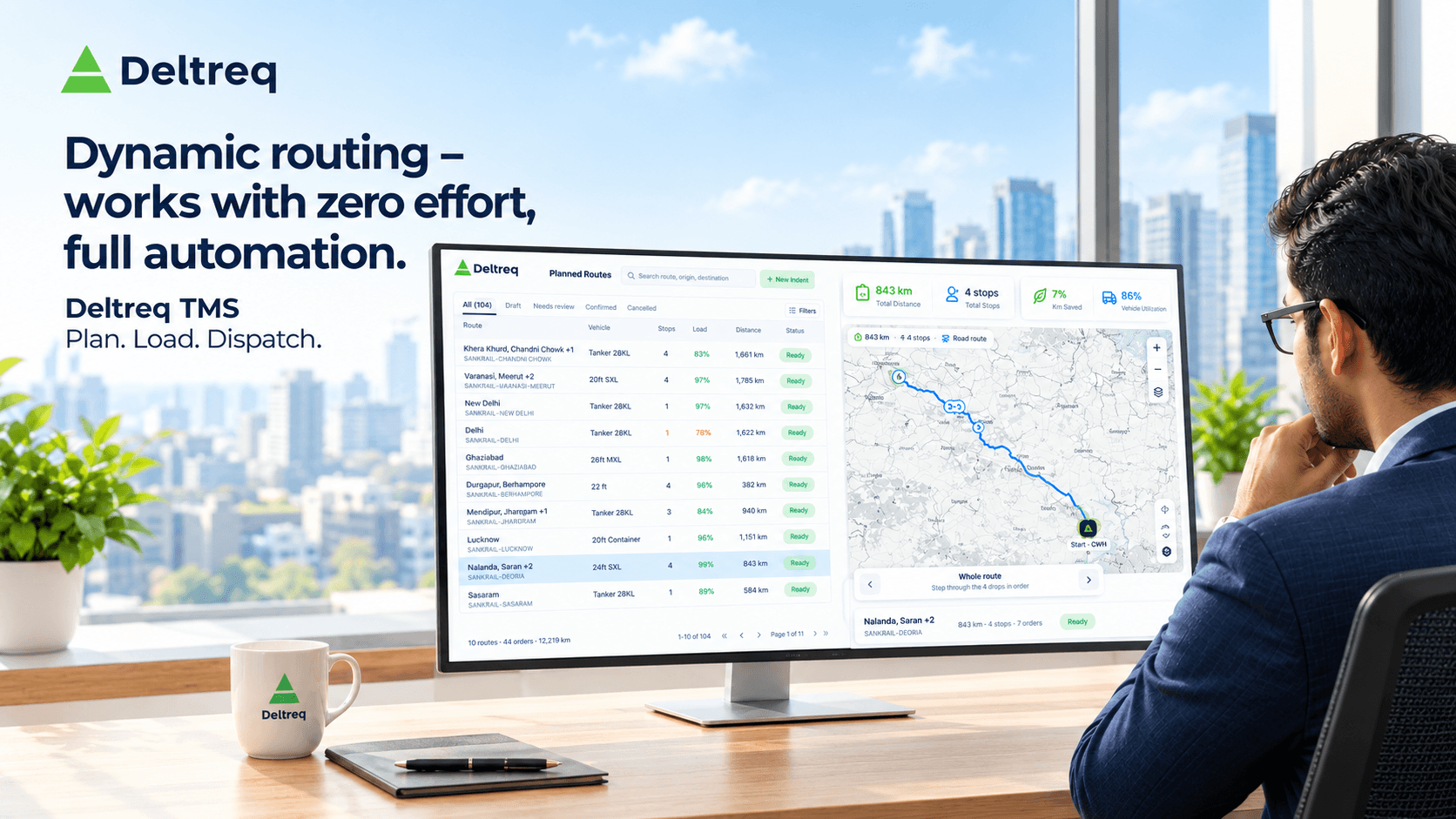
4. Dynamic Route Planning and Load Consolidation
Freight cost depends heavily on how well vehicles are filled.
• Automated route planning and multi-order clubbing
• Vehicle type selection
• Weight and CFT-based load planning
• Load fill percentage and delivery-stop visibility
5. Live Tracking and a Centralised Control Tower
For multi-hub operations, this is where the biggest change is felt.
• Live vehicle tracking and dispatch-to-delivery status
• Geofence alerts and delay or exception visibility
• Hub-wise operational monitoring from one dashboard
• Fleet calendar and capacity visibility
Operations teams stop chasing transporters by phone and start managing by exception.
6. Automated Client Invoice Generation
• Invoices generated automatically from trips and LRs
• Trip-wise freight breakup with base freight, loading, unloading and GST
• POD-linked invoice processing
• Credit and debit notes, payment recording and outstanding monitoring
• Rental invoices based on contracts
Faster, more accurate invoicing means faster cash collection.
7. Transporter Invoice Verification and Payment
• Agreed rates matched against completed trips
• Trip-wise payable calculation
• Vendor bill and payment tracking
• Revenue, expense and outstanding visibility
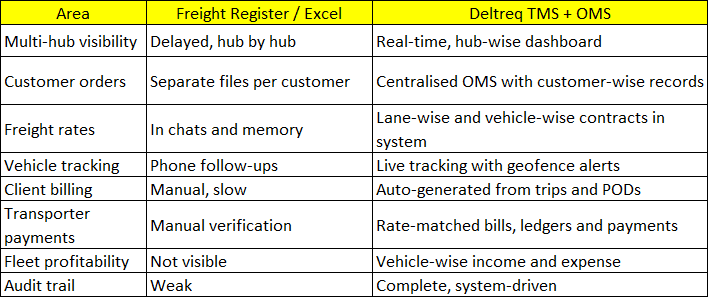
Register vs Excel vs Deltreq TMS: A Quick Comparison
The Complete 3PL Workflow on One Platform
Customer Order → OMS → Order Planning → Route Planning → Vehicle Procurement → Yard Management → Trip Creation → Dispatch → Live Tracking → POD Verification → Client Invoice Generation → Transporter Bill Verification → Payment Settlement
Every stage is connected, so there is no re-typing, fewer hand-offs and complete transaction visibility.
Who Should Move From Registers to a TMS?
Deltreq TMS is a strong fit if you are:
• A 3PL or transport company with two or more hubs or branches
• A regional logistics operator still managing freight in registers or Excel
• A company running own plus market vehicles together
• A business serving multiple customers with different billing terms
• A growing operator that wants to scale without adding manual work
Frequently Asked Questions
What is the best TMS software for 3PL companies in India? The best TMS for a 3PL is one that combines OMS, transportation, fleet management, freight procurement, tracking and billing in a single platform. Deltreq TMS is built for exactly this requirement.
Can one TMS manage multiple hubs and multiple customers? Yes. Deltreq provides a centralised OMS and control tower with hub-wise monitoring and customer-wise order, contract and billing configuration.
We still manage freight in registers. Is switching difficult? No. Orders can be imported from Excel, and rate contracts, vehicles and transporters can be set up once and reused, so teams move from manual entry to system-driven workflows quickly.
Can Deltreq manage both own fleet and market vehicles? Yes. Own, attached, leased and market vehicles are managed on the same platform, with separate cost tracking for own fleet and ledger management for market vendors.
Does Deltreq automate client invoicing and transporter payments? Yes. Client invoices are generated from completed trips and LRs, and transporter bills are verified against agreed rates before payment.
Conclusion: Growth Needs a System, Not Another Register
The future of 3PL operations is not only about moving cargo. It is about managing customers, orders, vehicles, transporters, freight costs and finances through one connected platform. As you add hubs and customers, the freight register becomes the bottleneck.
An integrated TMS and OMS gives 3PL companies the visibility, control and billing accuracy they need to scale.
Deltreq TMS: One Platform. Multiple Customers. Multiple Hubs. Complete Transportation Management.
Manage Orders. Optimise Fleet. Control Freight. Automate Billing.
Ready to Move Your 3PL Operations Off Registers?
Book a product demonstration with Deltreq and see how one platform can run your hubs, customers, fleet and freight from order to payment.