Logistics Cost Optimization: 7 Proven Strategies to Reduce Transportation Costs in India
Are You Paying More for Transportation Than the Market Rate?
Transportation is one of the major components of supply chain expenditure for FMCG, manufacturing, steel, textile and e-commerce companies.
But an important question most companies fail to ask is:
Are we paying the actual market freight rate, or are we paying more than the market benchmark?
Many organizations negotiate transportation rates with existing transporters without knowing the prevailing market price. As a result, they may continue paying higher freight rates, experience poor vehicle utilization and lose opportunities to reduce logistics costs.
In India, logistics cost typically ranges between 5% and 15% of revenue, depending on sector, product weight, distance to market and sales channel. Most companies measure only primary distribution, but logistics cost is much wider: it includes inbound freight, warehousing, primary distribution and secondary distribution. You cannot reduce what you do not measure.
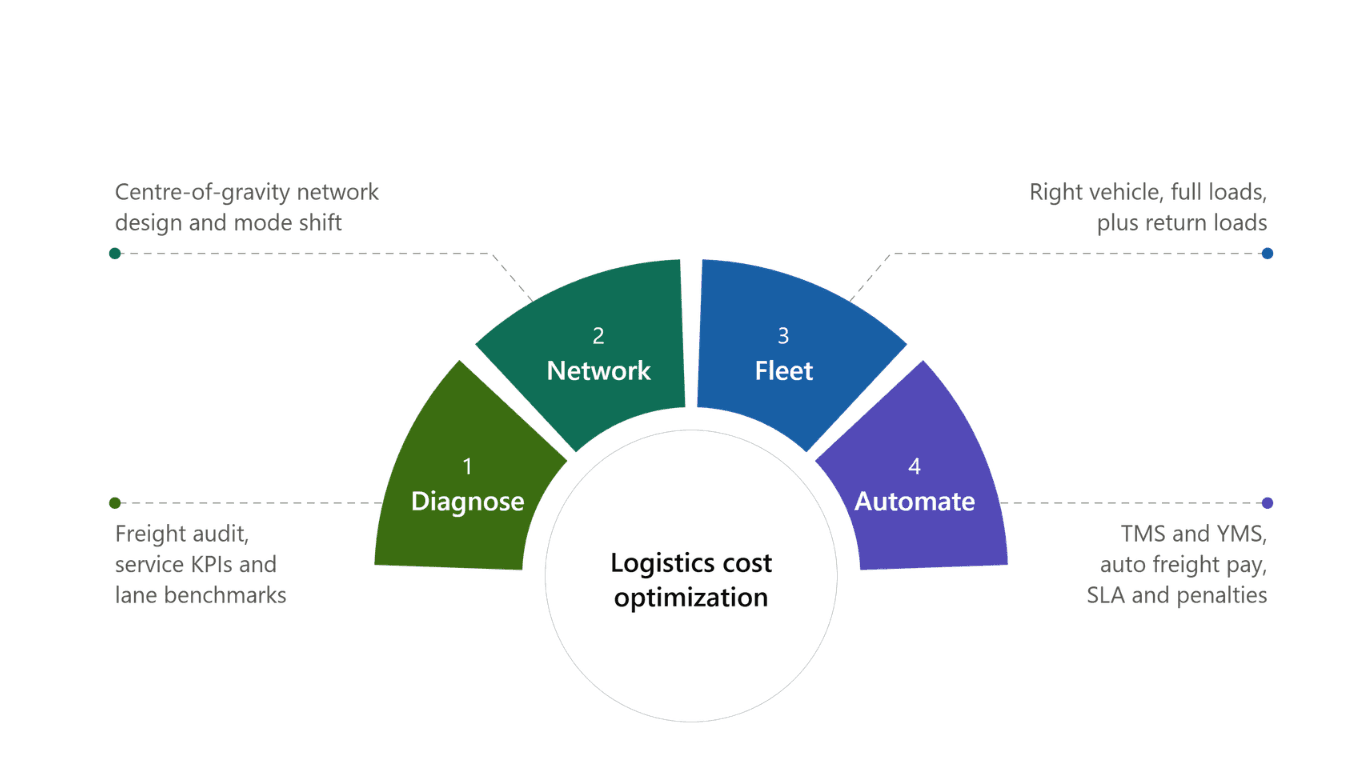
The framework below follows three simple principles -
1. Diagnose the current operation: run a freight audit and measure service, performance and cost levels.
2. Optimize the network, mode, fleet and contracts.
3. Automate logistics with technology (TMS/YMS) so that savings are sustained, not one-time.
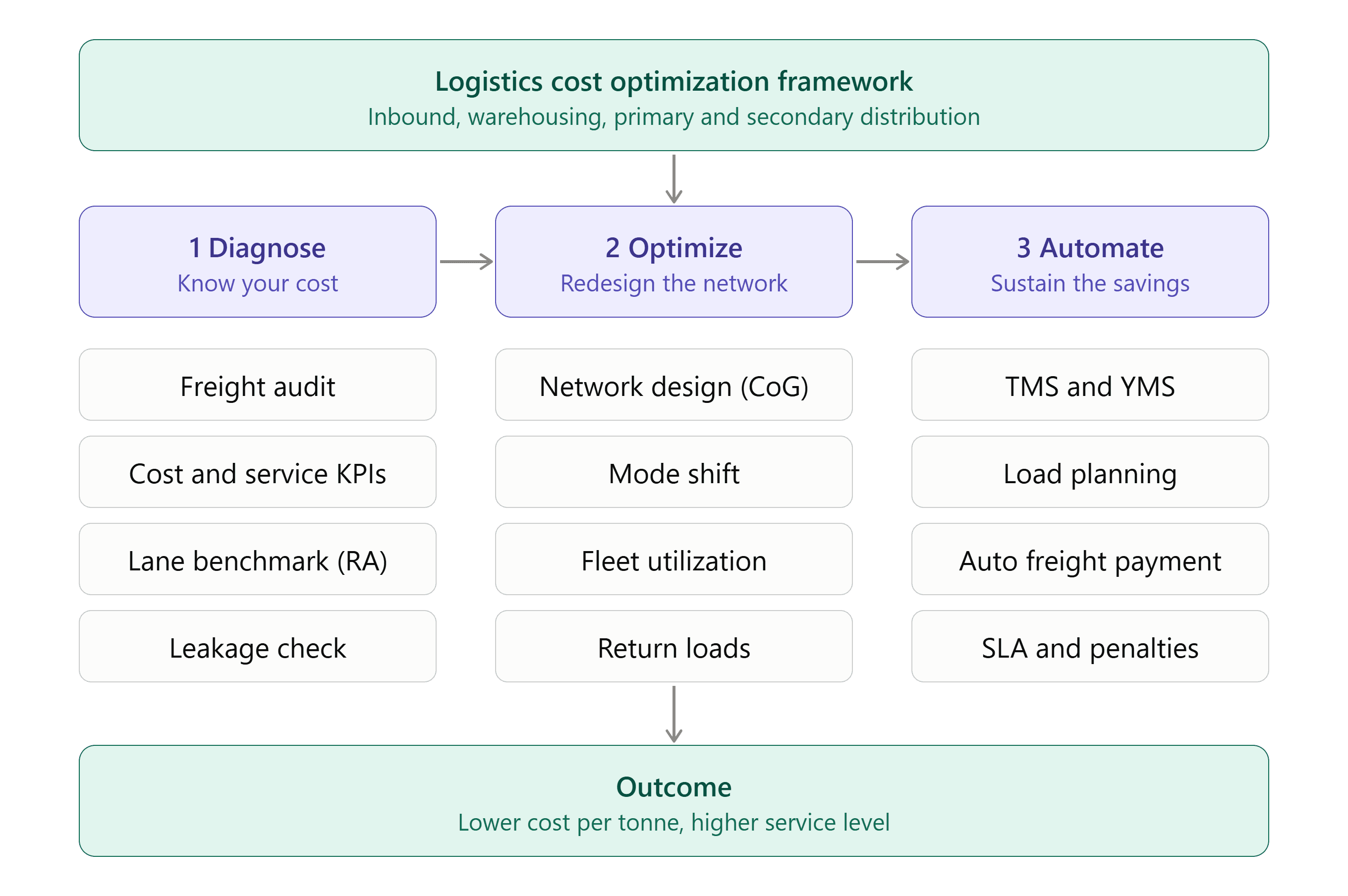
7 Strategies to Reduce Transportation Costs.
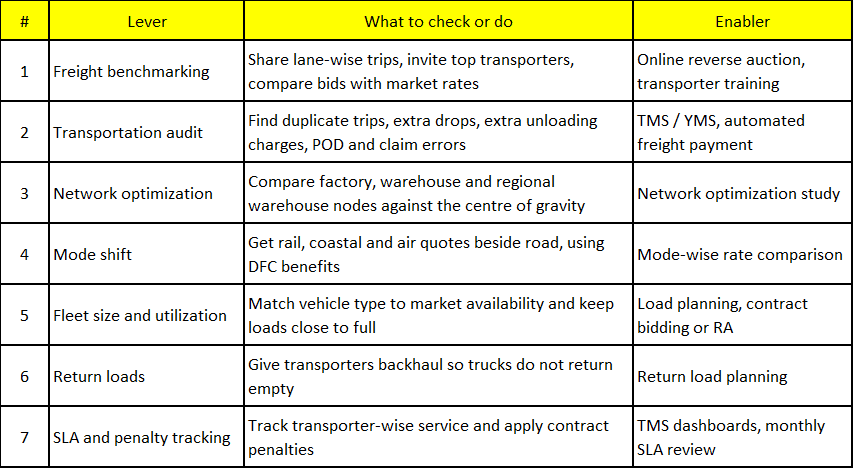
1. Benchmark Freight Cost with a Reverse Auction
Freight is the biggest component of logistics cost, so start here. If your freight is outsourced, run a reverse auction (RA) for freight cost benchmarking.
• Share your lane details and the number of trips carried on each lane.
• Invite your top transporters to a contract-based online reverse auction.
• Train transporters on online bidding so participation is high and fair.
• Compare the results with market rates to know where your freight stands.
Companies like Deltreq Technologies Pvt. Ltd. provide the online auction technology and transporter onboarding, so lane-wise rates are transparent and competitive.
2. Run a Transportation Audit to Find Leakages
When freight payment runs on Excel sheets or the traditional khatta system, the chance of freight leakage is high. Typical problems:
• Actual freight is never measured; analysis is based only on POD and invoice.
• A few employees in transport and freight hold more control than the company's overall control framework.
• Transporters add freebies, extra drop points, extra unloading charges and other add-ons.
• Duplicate trips are created and paid, sometimes unintentionally.
• Extra payment or short payment happens during POD verification.
• Claims are not settled correctly, which disappoints distributors.
A fully automated TMS or YMS closes these gaps with system-controlled trip creation, rate validation, POD matching and claim tracking. Tools like Deltreq TMS are built for this, and you can start with a free 1-month trial.
3. Optimize Your Network
Network design hits logistics cost harder than almost any other lever. Consider the trade-off: a location close to many customers may have expensive transport rates, while a cheap-rate location may be far from your customers. Then add warehouse cost at each location.
Review the full chain:
• Factory to warehouse
• Warehouse to regional warehouse
• Regional warehouse to customer
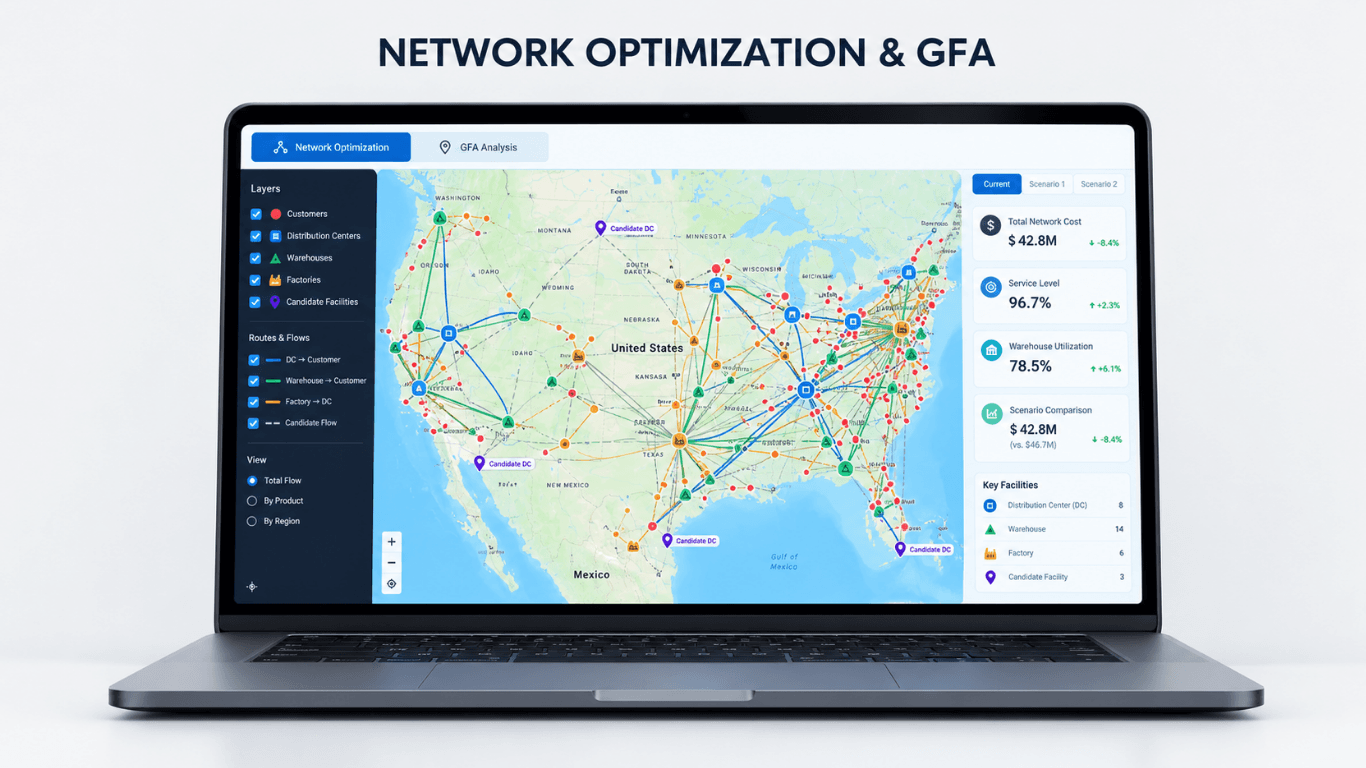
Check whether each node sits at the centre of gravity (CoG) of the demand it serves. A well-designed network reduces logistics cost strategically and improves service level at the same time. Deltreq also offers a network optimization tool and takes responsibility for delivering an accurate picture of your best network.
4. Shift the Mode: Road, Rail, Coastal, Air
Government policy is no longer focused only on road transport. Review which goods you handle and compare pricing across modes. If you move by road today, take a quote from rail as well. With the Dedicated Freight Corridors (DFC), rail transport cost and transit time are improving, which makes mode shift a real option for many bulk and long-haul lanes.
5. Check Fleet Size and Utilization
Companies sometimes hire the wrong vehicle model because the required size or tonnage is scarce in the market, and procurement cost goes up. To avoid this:
• Identify which vehicle type your operation actually needs.
• Check whether that vehicle is easily available in the market, then source it at the lowest cost.
• Make sure vehicles are close to fully utilized.
A TMS like Deltreq improves utilization through load planning, and contract bidding or RA shows which vehicle model gives the lowest cost.
6. Use Return Loads
Give your transporters return loads. When a truck does not run empty on the way back, the transporter's cost falls, and a good part of that benefit can be negotiated into your freight rate.
7. Track Transporter-wise SLA and Impose Penalties
Set clear SLAs per transporter: on-time delivery, transit time, damage, shortage and POD return time. Track them monthly and apply penalties as per contract conditions. Rewards for strong performers and penalties for weak ones keep service and cost under control.
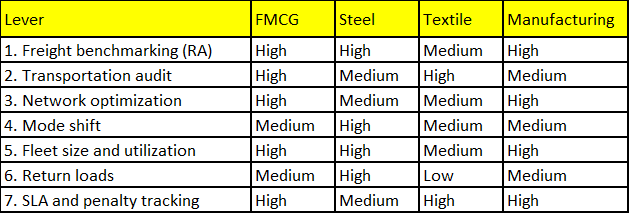
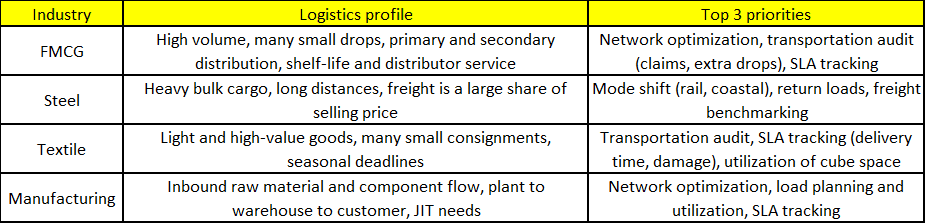
Industry-wise Priorities: Where to Start
The same framework applies everywhere, but the importance of each lever changes with product weight, value, order size and delivery pattern. The ratings below are indicative; validate them with your own lane and cost data.
How Does a Transportation Management System (TMS) Reduce Logistics Costs?
A Transportation Management System (TMS) helps companies manage and optimize transportation operations through a centralized digital platform.
Instead of depending on manual spreadsheets and disconnected processes, companies can automate key transportation activities.
A modern TMS should support:
- Freight procurement and reverse auctions.
- Transporter management and rate contracts.
- Automated trip and indent creation.
- Vehicle allocation and load planning.
- Real-time shipment tracking.
- POD and freight invoice verification.
- Transporter SLA monitoring.
- Transportation cost and performance dashboards.
Deltreq TMS combines transportation management, freight procurement, operational visibility and supply chain optimization to help businesses improve logistics control.
Why Choose Deltreq for Logistics Cost Optimization?
Deltreq Technologies Pvt. Ltd. provides technology-driven transportation and supply chain optimization solutions for manufacturing, FMCG and distribution businesses.
Its solutions include:
- TMS: Transportation planning, execution and shipment visibility.
- Online Reverse Auction: Competitive freight procurement and transporter bidding.
- OMS: Order management and distribution planning.
- Network Optimization: Distribution network and warehouse location analysis.
- Load Planning: Better vehicle utilization and shipment consolidation.
- Control Tower: Operational monitoring and transportation performance visibility.
The objective is to help businesses reduce unnecessary transportation expenditure, improve OTIF performance and create a more transparent supply chain.
Frequently Asked Questions (FAQs)
1. How can a company reduce transportation costs in India?
Companies can reduce transportation costs through freight benchmarking, reverse auctions, transportation audits, network optimization, vehicle utilization, return-load planning and automated transportation management.
2. How do I know whether my company is paying higher freight rates than the market?
Compare your existing lane-wise freight rates against competitive quotations from multiple transporters for the same vehicle type, route, load conditions and service requirements. Use the median competitive quotation as a reference benchmark.
3. What is freight cost benchmarking?
Freight cost benchmarking is the process of comparing existing transportation rates with prevailing market quotations to identify opportunities for reducing freight expenditure.
4. What is reverse auction in transportation?
A reverse auction is a competitive procurement process in which multiple transporters submit bids for a transportation requirement. Buyers can compare competitive offers and select suitable transporters based on price and service conditions.
5. How does TMS software reduce transportation costs?
TMS software helps reduce transportation costs by automating freight procurement, vehicle allocation, load planning, trip monitoring, freight verification and transporter performance management.
6. How can FMCG companies optimize logistics costs?
FMCG companies can optimize logistics expenditure through network design, freight benchmarking, shipment consolidation, secondary distribution planning, return-load utilization and transporter SLA monitoring.
7. What is the difference between freight cost reduction and logistics cost optimization?
Freight cost reduction focuses mainly on lowering transportation charges. Logistics cost optimization considers the entire supply chain, including transportation, warehousing, distribution, fleet utilization and operational efficiency.